Pepsin Enzyme for Cell Culture: How to Use Pepsin in Protein Hydrolysis Formulations
Pepsin for media and supplement producers making protein hydrolysates for cell culture: grade choice, process control, lot QC and how to request a quote.
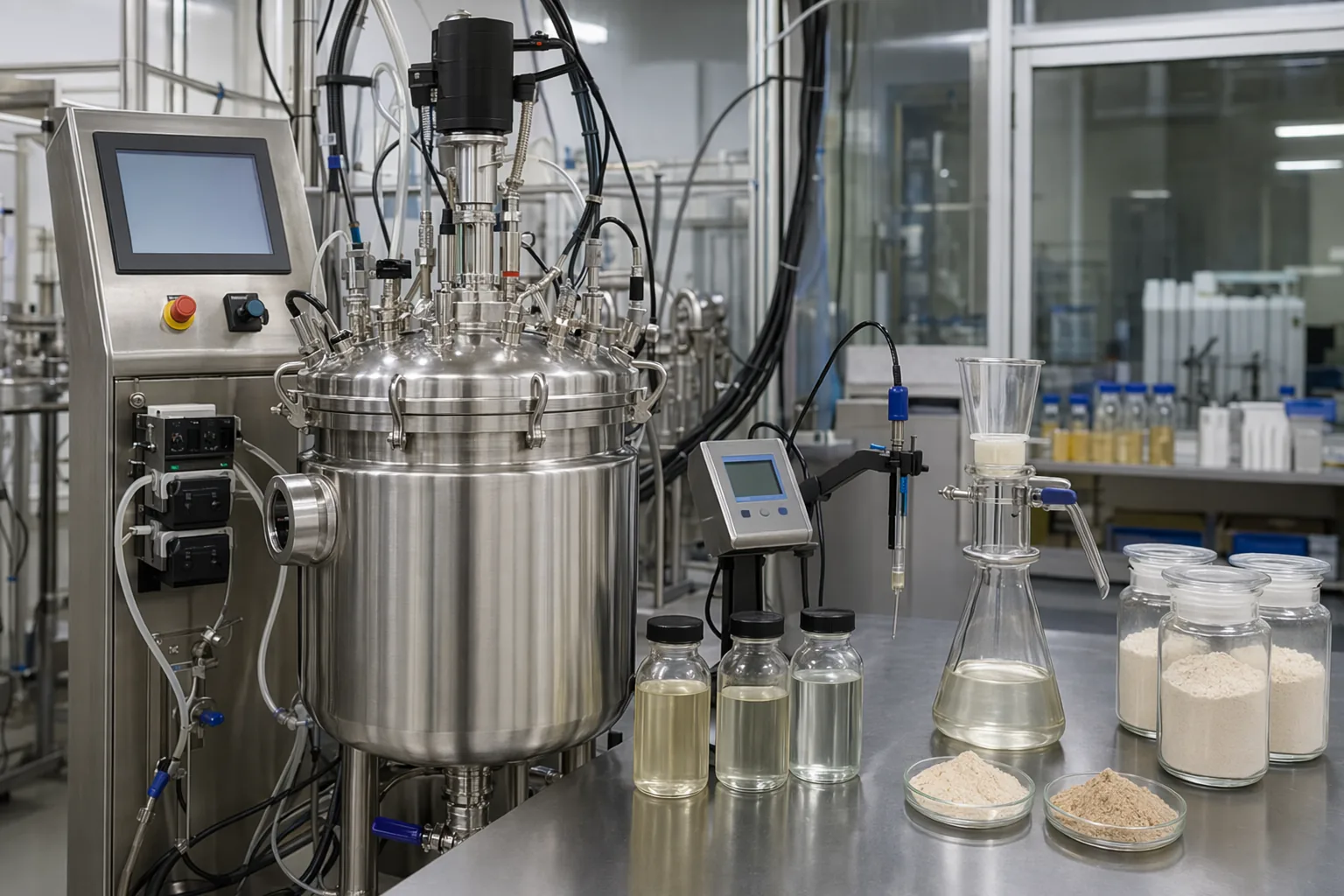
Media and supplement producers who make peptide hydrolysates for cell culture need the same peptide profile lot after lot; when it drifts, the problem shows up later as variable growth or productivity in the customer's process. Pepsin is one way to run that hydrolysis step at low pH. This guide covers what to specify, what to check, and what to send for a quote.
Our pepsin is specified at 1:10,000 – 1:15,000 NF, from porcine gastric mucosa, in 1 kg, 5 kg and 25 kg packs from a 1 kg minimum.
Why Pepsin Is Used in Cell Culture Hydrolysate Formulation
Pepsin enzyme for cell culture is typically used to convert protein substrates into soluble peptides and amino acid-rich hydrolysates that can support formulation development for media, feeds, and process supplements. Pepsin hydrolyzes proteins by cleaving peptide bonds preferentially near aromatic and hydrophobic amino acids under acidic conditions. This makes it useful when a manufacturer needs a defined acid proteolysis step before filtration, neutralization, blending, or downstream QC. In B2B production, the goal is not simply maximum hydrolysis; it is reproducible peptide distribution, low insoluble residue, acceptable impurity profile, and compatibility with the final cell culture application. Porcine pepsin is widely used industrially, but buyers should verify origin, activity unit definition, purity expectations, and regulatory suitability for the intended market. The right specification depends on the substrate, process constraints, and required performance in the final formulation.
Common substrates include casein, collagen, gelatin, albumin, soy protein, and other purified or semi-purified proteins. • Typical use cases include protein hydrolysis, collagen extraction, and specialized media component development. • Cell culture suitability must be proven by application testing, not assumed from enzyme activity alone.
Process Conditions: pH, Temperature, Dose and Time
Pepsin enzyme function depends strongly on pH. Our grade's optimum is pH 1.5–3.5 and 37°C–42°C; within that window the working point is set by substrate solubility, corrosion limits on the equipment and the neutralization load downstream. Dose is best set on an activity basis rather than by powder weight, because grades differ in strength, and it is fixed by trial against the degree of hydrolysis and peptide profile you need. Reaction time follows from the same trial. The right condition is the lowest cost-in-use that gives the required peptide profile, clarity and performance in the final application.
Start with small factorial trials covering pH, temperature, dose and hold time. • Keep agitation sufficient to prevent local acid or enzyme concentration gradients. • Record acid type, neutralizing agent, solids level and water quality, because all affect reproducibility.
Defining the Substrate of Enzyme Pepsin
The substrate of enzyme pepsin is protein, but industrial formulation requires more precision than that. The pepsin enzyme substrate may be an animal-derived protein such as collagen, gelatin, casein, or albumin, or a non-animal protein where acid proteolysis is suitable. Each substrate brings different solubility, buffering capacity, impurity load, allergen considerations, and downstream filtration behavior. For cell culture hydrolysates, the substrate choice influences peptide molecular weight distribution, free amino nitrogen, osmolality, color, odor, and potential growth or productivity effects. Before sourcing commercial quantities, define the acceptable substrate origin, pretreatment method, particle size, protein content, ash, moisture, microbial limits, and contaminant profile. If porcine pepsin is selected, confirm whether animal-origin documentation and traceability align with the buyer’s internal quality and customer requirements.
Collagen and gelatin often need acid conditioning or pretreatment before efficient hydrolysis. • Casein-based systems may need careful pH control due to buffering and precipitation behavior. • Substrate variability can have a larger effect than enzyme lot variability.
Inactivation, Clarification, and Downstream Control
After the target endpoint is reached, the reaction must stop reliably. Pepsin is usually inactivated by raising the pH toward neutral, with a validated heat step where the hydrolysate tolerates it. Confirm the stop by residual protease testing, because the matrix can protect some activity. Clarification may include centrifugation, depth filtration, microfiltration or activated carbon, depending on insoluble load, color, odor and bioburden requirements. For cell culture use, avoid introducing extractables, leachables, high salt or uncontrolled osmolality, and check sterile filtration early, because peptide-rich hydrolysates can foul membranes.
Verify residual enzyme activity after neutralization and heat treatment. • Track yield loss across each clarification or filtration step. • Confirm that final osmolality and conductivity fit the intended media formulation.
QC Checks for Cell Culture Hydrolysate Lots
A robust QC plan links enzyme performance to final hydrolysate functionality. Key analytical checks may include degree of hydrolysis, soluble protein, free amino nitrogen, peptide molecular weight distribution, pH, conductivity, osmolality, turbidity, color, moisture for powders, and ash. For cell culture-related materials, buyers commonly add bioburden, endotoxin, mycoplasma risk assessment, residual protease activity, heavy metals where relevant, and application testing in representative cell lines or media systems. No single enzyme activity value predicts cell culture performance, so pilot lots should be compared against a reference hydrolysate using growth, viability, productivity, or metabolite response metrics appropriate to the process. Release specifications should be realistic enough for manufacturing but tight enough to prevent performance drift. Keep retains and trend critical attributes across enzyme, substrate, and hydrolysate lots.
Use peptide mapping or size-exclusion methods when peptide profile is critical. • Set alert limits during development before locking commercial release limits. • Correlate analytical data with application performance whenever possible.
How to Qualify a Pepsin Supplier
A qualified pepsin supplier should provide documentation that supports both formulation development and commercial purchasing. At minimum, request a current COA, TDS, and SDS for the pepsin enzyme, plus the activity assay definition, recommended storage conditions, shelf life, country of origin, biological source, and lot traceability. For porcine pepsin, obtain clear animal-origin information and confirm whether the supplier can support customer-specific questionnaires. Commercial evaluation should include sample availability, lead time, packaging options, change notification practices, technical responsiveness, and lot-to-lot consistency. Supplier qualification is also an economic decision: a lower price per kilogram may be less attractive if activity is low, variability is high, or filtration losses increase. Compare vendors by cost-in-use, not headline price, using the same substrate, endpoint, and QC criteria.
Request pilot-scale lots before committing to long-term supply. • Confirm whether activity is reported per gram of preparation and by which method. • Review packaging compatibility with acidic or hygienic processing environments.
Technical Buying Checklist
Substrate and its origin (casein, collagen, gelatin, albumin or plant protein). • Target peptide profile and how you measure it. • Stop step and residual-activity test. • Release tests your customers ask for (bioburden, endotoxin, osmolality). • Source acceptability of porcine pepsin for your market. • Quantity per year and pack size: 1 kg, 5 kg or 25 kg.
How to Request a Quote
Request a quote by email or through the form on the home page. Send the product and grade, the quantity per order or per year, the destination country and your application. Packs are 1 kg, 5 kg and 25 kg, the minimum order is 1 kg, and we reply within 24 hours. Add the substrate and the hydrolysate you make if you want grade advice.
Pepsin for Research & Industry
Need Pepsin for your lab or production process?
ISO 9001 certified · Food-grade & research-grade · Ships to 80+ countries
Frequently Asked Questions
Is pepsin an enzyme used for industrial protein hydrolysis?
Yes. Pepsin is an enzyme classified as an acid protease. In industrial formulation, it is used to hydrolyze protein substrates into peptides under low-pH conditions. For cell culture hydrolysate development, the enzyme is evaluated for reproducible peptide generation, not for dietary or medical supplement claims. Performance should be confirmed through pilot trials and final application testing.
What is the substrate of enzyme pepsin in cell culture hydrolysate production?
The substrate of enzyme pepsin is protein. In cell culture hydrolysate production, common pepsin enzyme substrate options may include collagen, gelatin, casein, albumin, or selected plant proteins, depending on formulation requirements. The substrate must be qualified for origin, protein content, impurity profile, microbial quality, and consistency because substrate variation strongly affects the hydrolysate peptide profile.
What pH should be used for pepsin enzyme function?
Pepsin works in acidic systems; our grade's optimum is pH 1.5–3.5. The best point inside that window depends on substrate solubility, equipment compatibility, acid choice, target hydrolysis and downstream neutralization, so confirm it by measuring degree of hydrolysis, peptide distribution and application performance.
How should a buyer compare pepsin suppliers?
Compare pepsin suppliers using the same substrate, pH, temperature, dosage, and hydrolysis endpoint. Review COA, TDS, SDS, activity method, origin statement, traceability, storage guidance, and change-control support. Then calculate cost-in-use based on enzyme activity, yield, filtration performance, lot consistency, and hydrolysate quality, not only price per kilogram.
Related: Pepsin Enzyme Substrate & Function
Request pepsin samples, specifications, and pilot support for your protein hydrolysis formulation. See our application page for Pepsin Enzyme Substrate & Function for specs, MOQ, and a free 50 g sample.
Contact Us to Contributehello@mail.enzymepoint.com