Application of Papain and Pepsin Enzyme IgG for Industrial Buyers
Pepsin for diagnostic and research reagent producers making F(ab')2 fragments from IgG: grade choice, lot QC, documents and how to request a quote.
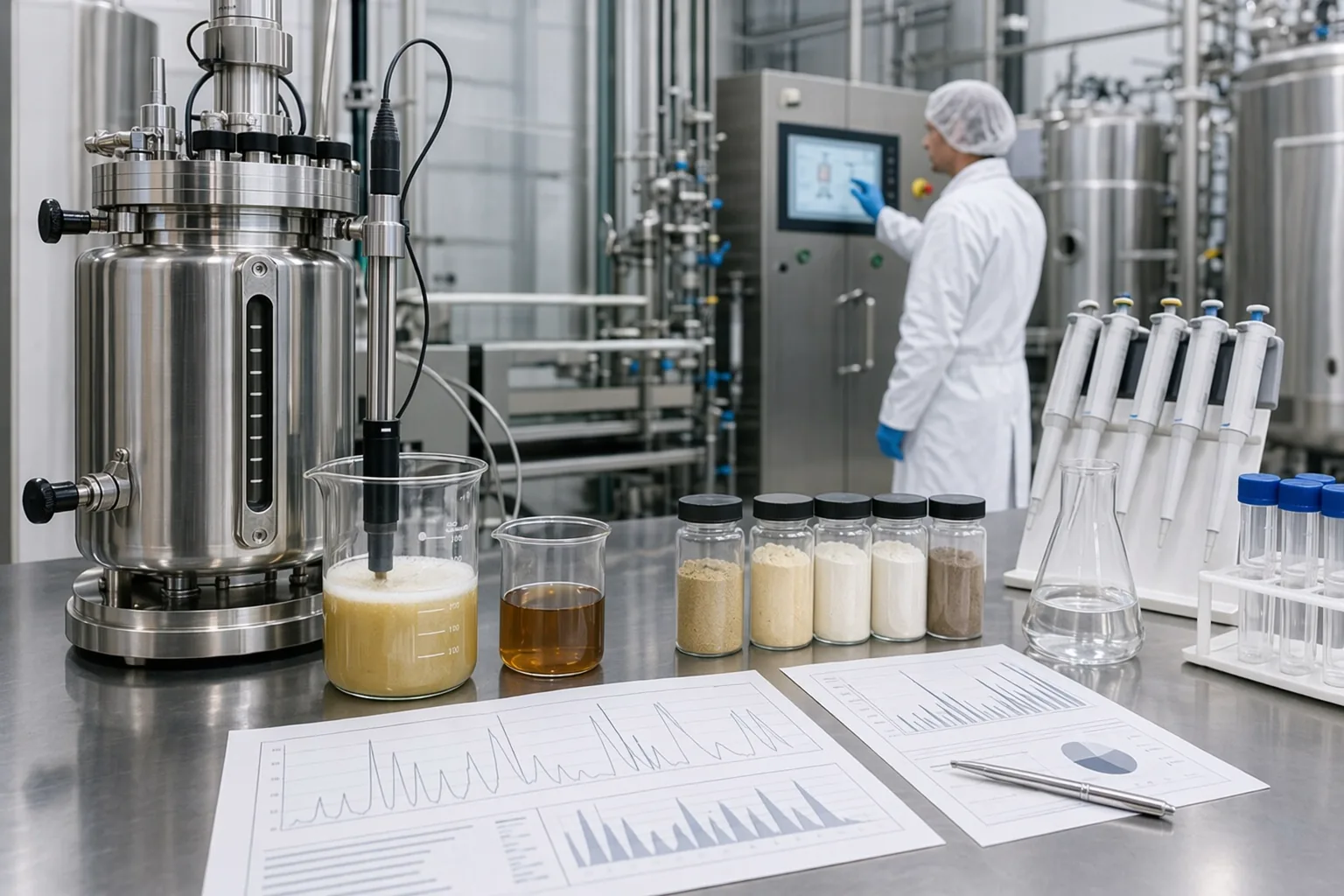
Diagnostic kit makers, antibody reagent producers and contract labs use pepsin to cut IgG into F(ab')2 fragments; papain is the usual choice when Fab and Fc fragments are wanted instead. This guide is for the buyer who sources the enzyme for that step: which grade to ask for, what to check on every lot, and what to send for a quote.
Our pepsin is specified at 1:10,000 – 1:15,000 NF, from porcine gastric mucosa, in 1 kg, 5 kg and 25 kg packs from a 1 kg minimum. Send the grade, quantity and destination and we quote per order.
Where Pepsin Fits in Antibody Fragment Production
Papain and pepsin are both proteases, but they cut IgG in different places and give different products. Papain is commonly used to generate Fab and Fc fragments, while pepsin produces a single F(ab')2 fragment under acidic conditions, which keeps both antigen-binding arms joined. For a reagent producer the choice follows the product you sell: F(ab')2 reagents and conjugates call for pepsin, Fab work usually calls for papain.
The buying question is therefore narrow: a pepsin grade with a defined activity, a declared source and lot documents, so that the fragmentation you validated in the lab repeats on every production lot. Treat IgG fragmentation as a controlled laboratory or manufacturing step and validate it with your own antibody and method.
Choose the enzyme by the fragment you need. • Confirm enzyme source, activity method and purity profile before scale-up. • Compare papain and pepsin on fragment pattern and process pH, not on price per kilogram.
What Decides the Result: Conditions You Control
Pepsin works in acidic conditions; our grade's optimum is pH 1.5–3.5 at 37°C–42°C. Antibody fragmentation protocols set their own buffer pH, enzyme-to-antibody ratio and incubation time, and those values belong to your validated method, not to a generic guide. What matters to the buyer is that the enzyme behaves the same way at the conditions your method fixes.
The usual failure is over-cleavage: the reaction runs past F(ab')2 and fragment yield falls. Under-cleavage leaves intact IgG in the product. Both are controlled by ratio, time and a defined stop step, usually a pH shift, and both show up first when a new enzyme lot is a little stronger or weaker than the last.
Fix pH, ratio, time and stop step in a written method. • Re-run a small fragmentation trial on every new enzyme lot before production use. • Keep the IgG source and buffer the same when you compare lots.
Lot QC for Fragment Work
Fragment production needs tighter control than bulk protein hydrolysis because the output is a defined fragment pattern, not a general peptide mixture. Test each enzyme lot with the same IgG source, buffer system and analytical method used in your process. Useful checks include SDS-PAGE, SEC-HPLC, residual intact IgG, fragment purity and protein recovery, plus bioburden and endotoxin where the end application requires them.
Use SDS-PAGE or SEC-HPLC to verify the fragment profile. • Define acceptance criteria for fragment yield, recovery and over-cleavage. • Keep the lot COA with your batch record.
Documents and Source Checks
Ask any pepsin supplier for a lot COA and a TDS, plus the activity method, recommended storage and the biological source. Our batches come with COA and TDS for qualified buyers. For porcine pepsin, confirm that the source is acceptable for your market, labeling and customers before the first trial, not after validation has consumed time and antibody.
Compare offers on cost per validated batch: enzyme price matters less than repeatable fragment yield, because the antibody you fragment is the expensive input.
Request the activity method with the COA. • Confirm source acceptability early. • Calculate cost per batch of finished fragment.
Technical Buying Checklist
Fragment target: F(ab')2 (pepsin) or Fab/Fc (papain). • Antibody species and subclass you fragment. • Your method's pH, enzyme-to-antibody ratio, time and stop step. • Lot QC acceptance criteria (SDS-PAGE or SEC-HPLC profile, residual intact IgG). • Grade wanted (NF/USP or EP) and source acceptability for your market. • Quantity per year and pack size: 1 kg, 5 kg or 25 kg.
How to Request a Quote
Request a quote by email or through the form on the home page. Send the product and grade, the quantity per order or per year, the destination country and your application. Packs are 1 kg, 5 kg and 25 kg, the minimum order is 1 kg, and we reply within 24 hours. If you want grade advice, add your current fragmentation method and the fragment you produce.
Pepsin for Research & Industry
Need Pepsin for your lab or production process?
ISO 9001 certified · Food-grade & research-grade · Ships to 80+ countries
Frequently Asked Questions
Which pepsin grade should a reagent producer specify?
Specify a defined-activity grade with a lot COA, because fragment yield has to repeat from lot to lot. Our grade is 1:10,000 – 1:15,000 NF from porcine gastric mucosa; tell us your method and the fragment you make and we confirm the fit before you order.
Can we order a small quantity for method validation?
Yes. The minimum order is 1 kg, and a free sample is included with every qualified inquiry, so a lab can validate its fragmentation method before a production order.
How are papain and pepsin used for IgG analysis?
In analyzing antibodies through papain and pepsin enzyme workflows, papain is commonly selected when Fab and Fc fragments are desired, while pepsin is used when F(ab')2 generation is the target. Conditions must be optimized for pH, enzyme-to-substrate ratio, time, and temperature. Analytical confirmation by SDS-PAGE, SEC-HPLC, or equivalent methods is recommended before routine use or scale-up.
What documents should a pepsin supplier provide?
A pepsin supplier should provide a lot-specific COA, TDS, and SDS at minimum. Buyers may also request source statements, storage guidance, retest period, activity assay method, packaging information, and application support. For porcine pepsin, source acceptability should be reviewed against customer, regulatory, and labeling requirements in the target market before commercial approval.
How should buyers compare pepsin enzyme prices?
Compare pepsin enzyme offers by cost-in-use, not only price per kilogram. A lower-priced product may require higher dosage, longer reaction time, or more downstream correction. Run pilot batches at matched activity levels, then compare yield, peptide profile, filtration, quality results, enzyme consumption, waste, and production cycle time. The best commercial choice is the enzyme that reaches specification reliably.
Related: Pepsin Enzyme Substrate & Function
Request pepsin enzyme samples, COA/TDS/SDS, and pilot-scale support from EnzymePoint for your protein hydrolysis project. See our application page for Pepsin Enzyme Substrate & Function for specs, MOQ, and a free 50 g sample.
Contact Us to Contributehello@mail.enzymepoint.com