Brewing Pepsin Enzyme: Specification Checklist for Brewing Buyers
Compare brewing pepsin enzyme specs for acidic protein hydrolysis, pilot trials, COA/TDS/SDS review, QC checks, and supplier qualification.
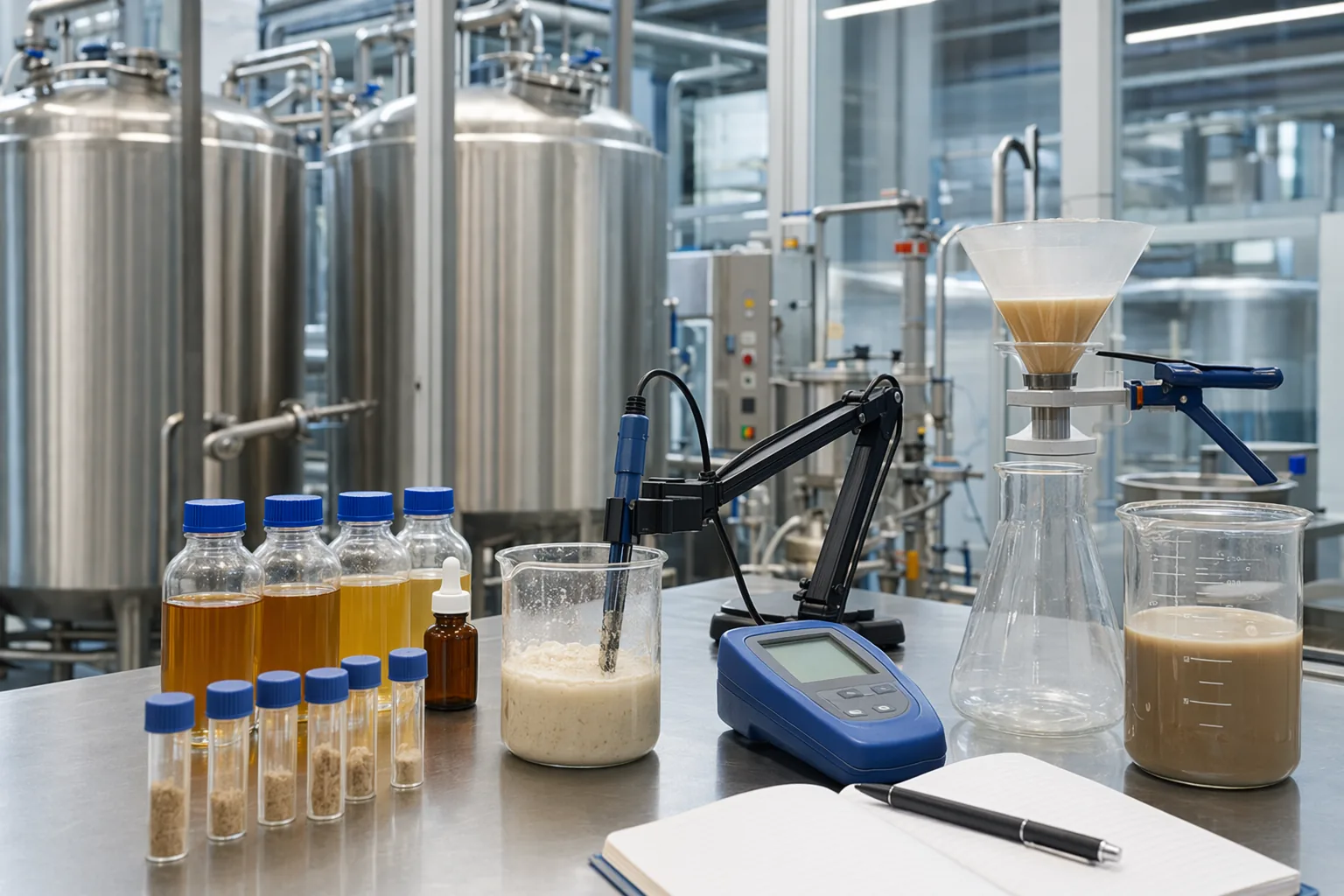
Brewing pepsin enzyme is not a general-purpose mash enzyme. It is a specialized acidic protease that may help breweries, ingredient processors, and brewing-adjacent manufacturers when the process objective is controlled protein hydrolysis at low pH. The buying decision should therefore begin with process fit, not with the highest activity number or the lowest price per kilogram.
In practical terms, pepsin is most relevant for acidified protein streams, specialty adjunct treatment, yeast nutrient ingredient preparation, protein hydrolysate production, or side-stream trials where the substrate can be held under acidic conditions. It should not be assumed to work efficiently in a standard mash, because normal mash pH is usually far above the strongest operating window for pepsin activity.
For B2B buyers, the correct specification checklist combines enzymology, plant reality, documentation, and commercial risk. A suitable product must match the substrate, pH, temperature, residence time, solids content, stop condition, sensory target, and downstream filtration requirement. The supplier also needs to support comparison by activity method, origin, COA, TDS, SDS, traceability, storage stability, and batch consistency.
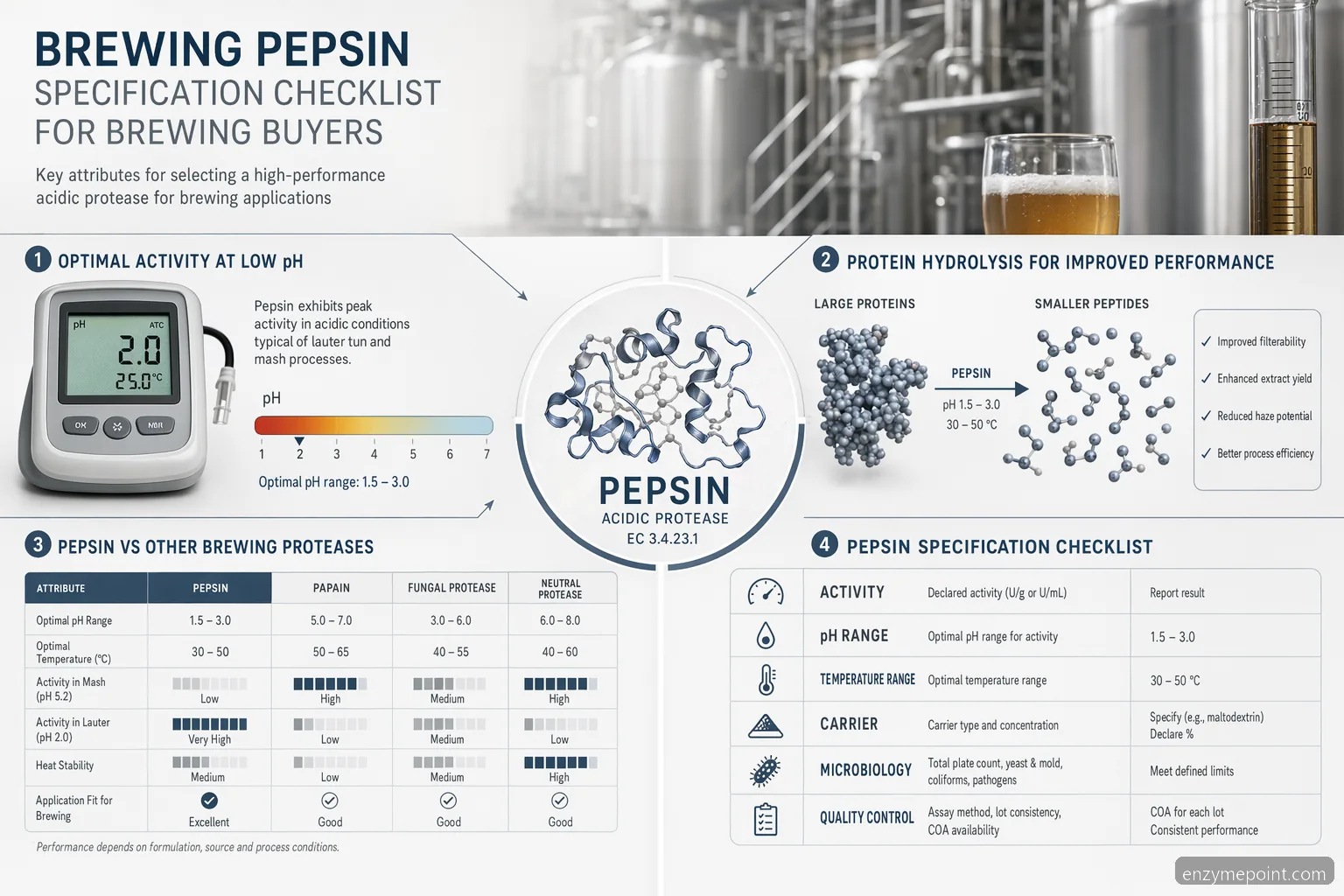
Where does brewing pepsin enzyme fit in a brewing-related process?
**Brewing pepsin enzyme fits best in acidic protein treatment steps where the buyer needs controlled hydrolysis before blending, separation, or further processing, rather than in a conventional mash. Its value depends on maintaining a low-pH environment, exposing the intended protein substrate, and validating final impacts on flavor, foam, haze, and filtration.**
Pepsin is an acidic protease, so its strongest process logic is not the standard cereal mash but an acidified side stream or ingredient preparation step. A brewery or ingredient processor may evaluate it for acidified cereal protein streams, protein hydrolysates, specialty yeast nutrient ingredients, collagen-derived inputs, gelatin-containing streams, or other protein-rich materials that require solubilization under acidic conditions.
The limiting factor is process pH. A typical mash is commonly around pH 5.2 to 5.6, while pepsin is associated with much stronger activity in acidic systems. If the process cannot be acidified, held, and then stopped or adjusted in a controlled manner, a different protease class may be more practical. Buyers reviewing pepsin chemistry can use [Pepsin Enzyme Substrate & Function](https://enzymepoint.com/applications/pepsin-enzyme-substrate-function/) to align enzyme function with the actual protein stream.
The final decision should be based on the result in the brewing process, not on hydrolysis alone. Excessive or poorly controlled protein breakdown can affect foam-active proteins, haze formation, filterability, mouthfeel, nitrogen balance, and sensory perception. A useful pepsin trial therefore proves both protein conversion and product quality under the intended plant conditions.
How should buyers compare pepsin with other brewing proteases?
**Buyers should compare pepsin with other brewing proteases first by process pH, then by substrate response, downstream quality, and documentation quality. Pepsin is mainly a low-pH protein hydrolysis tool, while neutral or alkaline proteases may be better suited to higher-pH mash, wort, or adjunct processing conditions.**
Pepsin, papain, bromelain, fungal proteases, and bacterial neutral proteases all hydrolyze proteins, but they do not behave interchangeably. Each enzyme class has a different pH preference, temperature tolerance, substrate selectivity, peptide profile, and inactivation behavior. Pepsin is strongest when the design requirement is acidic hydrolysis. If the process is closer to neutral pH, buyers should not expect pepsin to deliver the same conversion simply because the product has a high activity value on paper.
The substrate also matters. The enzyme pepsin digests proteins by cleaving peptide bonds, but reaction speed and hydrolysate profile depend on the structure and processing history of the protein. Malt proteins, cereal adjunct proteins, gelatin, collagen-derived materials, and other ingredient streams should be tested separately. For broader protein-processing context, buyers can compare the principles in [The Enzyme Pepsin Hydrolysis for Industrial Protein Processing](https://enzymepoint.com/learn/the-enzyme-pepsin-hydrolysis/).
A fair supplier comparison uses the same substrate, pH, temperature, residence time, solids level, and analytical endpoints. Activity units alone are not enough because assay methods may use different reference substrates and conditions. The winning product is the one that meets the required hydrolysis target while preserving acceptable foam, turbidity, filterability, flavor, and process control.
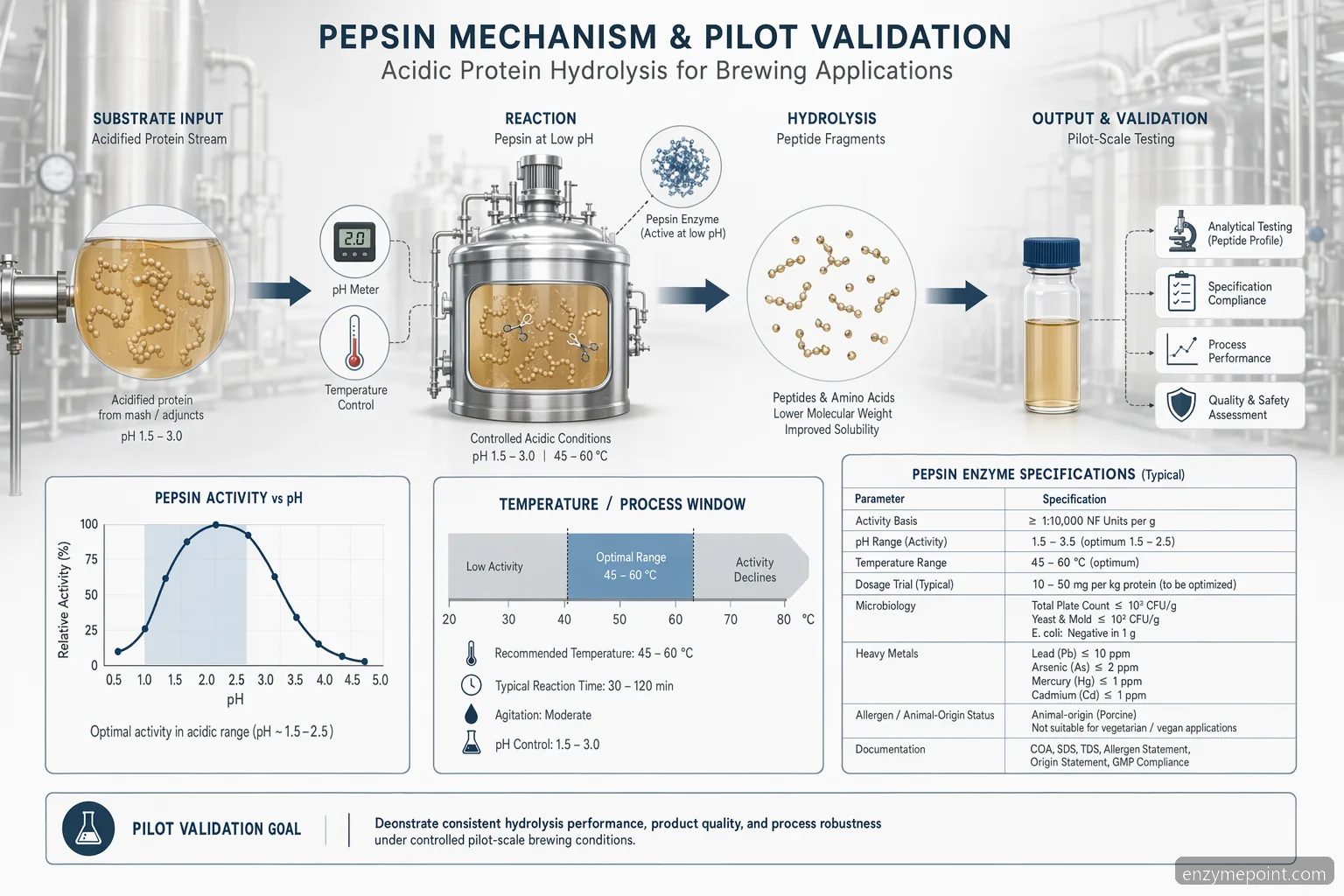
What process conditions should be validated in a pepsin pilot trial?
**A pepsin pilot trial should validate pH, temperature, residence time, solids content, dosage band, pH drift, stop condition, and downstream quality using the buyer’s real protein substrate. The objective is to confirm controlled acidic hydrolysis without creating unacceptable sensory, filtration, foam, stability, or yield problems at scale.**
A practical pilot should bracket the supplier’s technical data rather than copy a generic dosage from an unrelated application. Common screening conditions for pepsin enzyme include acidic pH around 1.5 to 3.5, temperatures around 30 to 55°C, and residence times ranging from 30 minutes to several hours, depending on substrate accessibility and target degree of hydrolysis. Dosage should be screened according to the supplier TDS, often as activity relative to protein or as a product addition band.
The trial should include pH drift monitoring during the hold. Pepsin activity generally declines as pH rises, so the actual pH profile during processing may explain weak or inconsistent hydrolysis. Temperature should be checked at the product mass, not only at the jacket or water bath. Solids content, mixing, particle size, and substrate pretreatment can also affect how effectively the enzyme reaches the protein.
Define the stop condition before the trial begins. Options may include heat inactivation, pH adjustment, separation, blending, or another process-specific control. Measure soluble nitrogen, free amino nitrogen where relevant, peptide distribution if needed, turbidity, filterability, foam indicators, and sensory risk. More detailed operating concepts are covered in [Pepsin for Protein Hydrolysis: Dosage, pH, and Temperature](https://enzymepoint.com/learn/pepsin-for-protein-hydrolysis/).
What should a brewing pepsin enzyme specification include?
**A brewing pepsin enzyme specification should include activity method, assay conditions, biological origin, substrate suitability, appearance, solubility, carrier or excipient information, moisture where provided, microbiological limits, heavy metals where relevant, COA, TDS, SDS, storage conditions, shelf-life guidance, traceability, and change notification expectations.**
The first specification item is activity, but the activity value must be interpreted with the assay method. Buyers should request the test substrate, assay pH, assay temperature, calculation basis, and unit definition. Activity units from different suppliers may not be directly interchangeable. A lower apparent number from one method may perform better than a higher number from another method if the real process substrate and pH are more favorable.
Origin is also important. Pepsin is commonly associated with animal origin, such as porcine pepsin, and that origin may affect customer acceptance, market access, labeling position, internal purchasing policy, and end-use restrictions. Buyers should confirm origin suitability before commercial purchase, not after a plant trial has already consumed time and budget. Any allergen, dietary, or origin-sensitive customer requirement should be reviewed through the buyer’s own regulatory and quality process.
Documentation should include a current COA for the supplied lot, a TDS for handling and application guidance, and an SDS for safety controls. Additional comparison points include packaging integrity, storage temperature, shelf-life, appearance, solubility, excipients or carriers, microbiology, and heavy metals where relevant. For troubleshooting powder performance, [Pepsin Enzyme Powder for Protein Hydrolysis Troubleshooting](https://enzymepoint.com/learn/pepsin-enzyme-powder/) gives useful context on practical evaluation.
How should buyers evaluate quality control and cost-in-use?
**Buyers should evaluate brewing pepsin enzyme by cost per effective treatment, not price per kilogram, because the real cost includes delivered activity, validated dosage, yield impact, acidification or neutralization needs, filtration behavior, waste handling, receiving QC, batch consistency, and supplier support during scale-up.**
Receiving QC should verify that the delivered material matches the order, COA, and specification. Inspect the packaging condition, lot number, appearance, shelf-life, and storage instructions. Where the buyer has internal testing capability, lot activity or performance should be checked against the COA or against an established in-house substrate test. If internal testing is not available, retain reference samples and trend plant performance by lot.
Cost-in-use should include the complete treatment system. Acidification may require raw materials, equipment time, corrosion review, pH monitoring, and neutralization or blending after hydrolysis. If pepsin improves solubilization but worsens turbidity or filter loading, the enzyme may raise total process cost. If it improves protein conversion without sensory penalty, it may justify a higher purchase price than a lower-activity or less consistent option.
Scale-up should compare plant data against the pilot baseline. Track pH, temperature, hold time, mixing, protein conversion, turbidity, filtration, sensory results, and any deviations in downstream performance. Supplier qualification should include documentation responsiveness, traceability, lot consistency, change notification, and technical support. A qualified supplier helps translate the specification into a controlled process, not only a delivered enzyme powder.
What buying risks should be resolved before ordering brewing pepsin enzyme?
**Before ordering brewing pepsin enzyme, buyers should resolve risks related to pH fit, substrate variability, origin acceptance, documentation completeness, activity method differences, sensory impact, filtration behavior, storage stability, regulatory review, and supplier qualification. These points determine whether the enzyme can become a reliable plant input rather than a laboratory curiosity.**
The first risk is assuming that pepsin will behave like a general brewing protease. If the planned use is a normal mash or wort step at higher pH, pepsin may be a poor fit unless the process includes a controlled acidic treatment phase. The buyer should define exactly where the enzyme is added, what substrate it contacts, how long it reacts, and how the reaction is stopped.
The second risk is inconsistent substrate response. Malt lot, adjunct type, prior heat treatment, particle size, and protein source can all change hydrolysis behavior. A pepsin product that performs well on a laboratory reference protein may not deliver the same result on the buyer’s plant stream. Matched trials using actual material are essential, especially if the target is a yeast nutrient ingredient, specialty protein hydrolysate, or acidified adjunct stream.
The third risk is commercial qualification. Origin-sensitive materials require market and customer acceptance checks. Documentation must be complete enough for purchasing, quality, EHS, and regulatory review. Buyers comparing enzyme options in adjacent industrial uses may find additional context in [Application of Papain and Pepsin Enzyme IgG for Industrial Buyers](https://enzymepoint.com/learn/application-of-papain-and-pepsin-enzyme-igg/), but brewing use still requires its own process-specific validation.
Pepsin for Research & Industry
Need Pepsin for your lab or production process?
ISO 9001 certified · Food-grade & research-grade · Ships to 80+ countries
Frequently Asked Questions
Is pepsin an enzyme suitable for direct mash addition?
Pepsin is an enzyme, specifically an acidic protease, but direct mash addition is usually not the best assumption. Standard mash pH is commonly much higher than the strongest pepsin activity window. Buyers should evaluate pepsin in an acidified side stream or specialty ingredient process before considering plant use.
What is the practical substrate for pepsin in brewing-related trials?
The practical substrate is the buyer’s actual protein-containing material, not only a laboratory reference protein. It may be malt protein, cereal adjunct protein, gelatin, collagen-derived material, yeast nutrient input, or another process stream. Each substrate should be tested separately because structure and processing history influence hydrolysis.
Which documents should be requested from a pepsin supplier?
Buyers should request a current COA, TDS, and SDS, along with the activity method, assay conditions, biological origin, storage guidance, shelf-life, microbiological information, and heavy metals data where relevant. The COA should match the lot being supplied. Documentation responsiveness is also part of supplier qualification.
Why can two pepsin products with similar activity perform differently?
Activity units may be based on different assay substrates, pH values, temperatures, and calculation methods. Real process performance also depends on substrate accessibility, pH control, temperature, mixing, solids content, and residence time. Matched pilot trials are the most reliable comparison method.
How should a brewery decide whether pepsin is worth scaling up?
Scale-up should proceed only when pilot results show the required protein hydrolysis and acceptable downstream quality. Buyers should confirm soluble nitrogen or related targets, filterability, turbidity, foam indicators, sensory impact, and process repeatability. Cost-in-use should include enzyme price, acidification, neutralization, yield, filtration, and waste handling.
Related: Pepsin Enzyme Substrate & Function
Turn This Guide Into a Supplier Brief Request a brewing pepsin enzyme specification review, sample, and pilot-trial discussion from EnzymePoint. See our application page for Pepsin Enzyme Substrate & Function at /applications/pepsin-enzyme-substrate-function/ for specs, MOQ, and a free 50 g sample.
Contact Us to Contributehello@mail.enzymepoint.com